

Building Team Spirit: 5 Actionable Tips for an Unstoppable Team

Why team spirit? Studies show that companies with satisfied employees are more successful. Excellent teamwork and a positive team spirit are feel-good factors. Team spirit is a growth factor, which is why more and more companies are relying on sustainably putting together powerful teams.
As an event host and keynote speaker, I repeatedly see team building activities that strengthen team spirit and ultimately increase results in the workplace. In this article, you’ll learn tips and tricks for building team spirit – from small groups to entire stadiums.
What is team spirit?
Team spirit is formed through a sense of belonging together within a group. It is characterized by attitudes and behaviors that subordinate individual interests to a common goal and a sense of unity. Promoting team spirit should be in the best interest of companies to improve productivity and ensure economic success.
The five pillars of team building
As the stadium announcer for the Austrian national football team, I like to use sports analogies to describe team spirit. Sports teams and teams in companies are not that different. In sports, however, some factors are more obvious and once they are understood, the transfer to a company is easy to comprehend. So let’s dive into the five fundamentals of how you can strengthen team spirit to create a positive work environment.

1. A sense of belonging
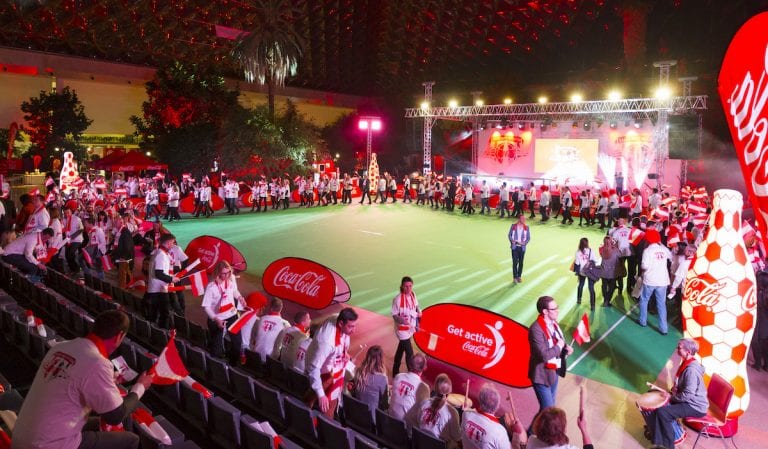
Team spirit is closely linked to a sense of belonging or a shared identity. In sports, the team consists not only of the players who are on the field and wear the same jersey. The substitutes and coaches also wear the club or country’s colors. The same applies to the fans who support the team on the field and drive them to peak performance. They all wear the same shirts, the same colors.
What does that mean for a team in a company? The team’s identity is roughly defined by the corporate culture and the company’s values. However, its specific form also depends on the team’s mission and internal team dynamics. There are several factors that go to make up a good team spirit.

Free KEYNOTE SCOUT-checklist to get your ideal keynote speaker
Click on the button below to get your free KEYNOTE SCOUT-checklist on how to find the perfect keynote speaker for your event.
Clear responsibilities in the team
Every team member has a fixed role in the team. Ideally, they will be deployed according to their abilities in order to collaborate effectively. It’s like in sports. The goalkeeper plays as a goalkeeper because that’s what he can do best. And no one would think of putting the physiotherapist in the midfield.
Bill Belichick, the most successful NFL coach in history, had a simple credo: “Do Your Job”. Every player knew exactly the job role attributed to him. The clearer the description of the activities, the more everyone can rely on the fact that he or she knows what is required of them.
Take responsibility
You become a real team player when you take responsibility for the assigned tasks. Being aware of your responsibility also means that the other team members can rely on you. But responsibility also means standing up for each other in the whole team.

Ability to cooperate
Teamwork is not for lone fighters. In sport, there is no such thing as a lone fighter, because even an individual athlete has formed a team around him, with a trainer, physiotherapist, sponsors, etc.
The ability to cooperate includes various characteristics such as empathy (understanding the problems of others), ability to accept criticism (giving and taking feedback) and flexibility (ability to react to changing conditions). The ability to share is also very important for a good team, not only success and failure, but also ideas, experiences and knowledge.
Cultivating relationships
Solidarity also arises when relationships reach personal level. This lowers the threshold for helping others and standing up for them.
Team members don’t have to be best friends, but they should treat each other with respect and appreciation and recognize each other’s strengths (and weaknesses). Only with these prerequisites can a working atmosphere be created in which employees and colleagues form a team.
Team building exercises can be implemented particularly well in this area. Be it joint events, games, fun team building activities, or other training and development opportunities.

2. The team members – collective heroes
It is inevitable that some team members are more exposed than others. A successful goal scorer typically gets more attention than a defender. But everyone is a hero in their own way, contributing to the team’s success. And in a team with a strong team spirit, such big and small heroic deeds are team achievements which are acknowledged by the entire team.
While in sports, typically the players on the field are the heroes, the aspect of collective heroes in a company is different. When an employee naturally fills in for a sick colleague, or when another employee has a brilliant idea that advances product development, then both are heroes. But customers can be heroes too, for example by confidently putting their trust in a new product or providing valuable input.
What does this mean for team composition?

Diversity – It’s all in the mix
Different professional skills are essential to put together a successful team. But a strong team also needs different character types. The hesitant, safety-oriented guy has just as much right to exist as the risk-taking character. In addition, a good mix of older, experienced employees and young, curious colleagues gives a team the right touch.
Continuous team development as shared progress
Stagnation is considered a step backwards. This also applies to the team composition. An efficient team must also be able to cope with change. Long-term goals often cannot be achieved with one and the same team. This also happens in sports when players change clubs in the middle of the season. A diverse team has a significantly greater ability to integrate because new team members will find a point of contact much faster.

3. Common goals
Team goals are crucial. Without goals, a team doesn’t have orientation. Motivation can only arise when the common goal is clear.
In sports, clear goals are usually set: “We want to win the championship!” or “We want to win the tournament!” The formulation of the goal alone makes it clear that the team concept is in the foreground. The “We” matters.
In today’s working world, it is often neglected to issue specific team goals. It is important that employees “buy into” the goal – that they can identify with it.
Depending on how far the team concept is defined in a company, the goals must also be formulated to fit perfectly. That’s the job of the managers and team leaders.
Good leadership
Every management handbook states that goals must be SMART. But in my opinion, inspiring employees and encouraging team members to achieve common goals is an underestimated art.
To do this, it is essential that goals are not simply given out, but that they are also justified. Why are we aiming for these sales figures? Why does the product launch have to follow this ambitious schedule? The communication around this must be transparent and comprehensible.
Good leaders are able to make the meaning and advantages of the goals plausible. Visionary leadership ensures that employees recognize the company’s goals as their own. A team member with intrinsic motivation automatically contributes more to success than someone who does not understand the objective.
Interim goals
Sometimes it is also helpful to formulate intermediate goals. These are easier to grasp and understand. “We want to win the next game” is more direct in its message and prevents complacency from creeping in on the way to the season’s goal.
Strengthening team spirit through incentives
Whether it’s promoting the inner team spirit, cohesion or motivation of the individual team members, incentives are an important building block for strengthening the team spirit. It is not primarily about individual bonuses, but about incentives that honor the team effort. This can also include joint activities outside of the workplace that further promote team building.

4. Common opponents: Does a team need an enemy?
In sports, success is all the sweeter when it is achieved against the archrival. When the Austrian national team wins against the Germans, the atmosphere is electric. A game against the main competitor gives an extra boost of motivation. In such a situation, it almost goes without saying that team spirit will be fostered.
In the business world, there are also main competitors. Apple vs. Samsung, Nike vs. Adidas, there are many examples. The competitor is always a benchmark that should motivate.
In a team within a company, however, the opponent can also be more abstract. A tight budget, an ambitious schedule or political conditions can stand in the way of success. A good team is aware of such challenges and embraces them.
However, what must not happen under any circumstances is that the opponent is seen within one’s own company. If the sales department thinks that marketing has launched a bad product, that is not an optimal starting position for good teamwork. If the wifi is not working again, it does not help to grumble at the IT department. This would ignore the fact that all are in the same boat. In sports, you would say they are all wearing the same colors. It’s about identifying what you have in common, being clear about the goal and who the real opponent is.
5. Shared rituals
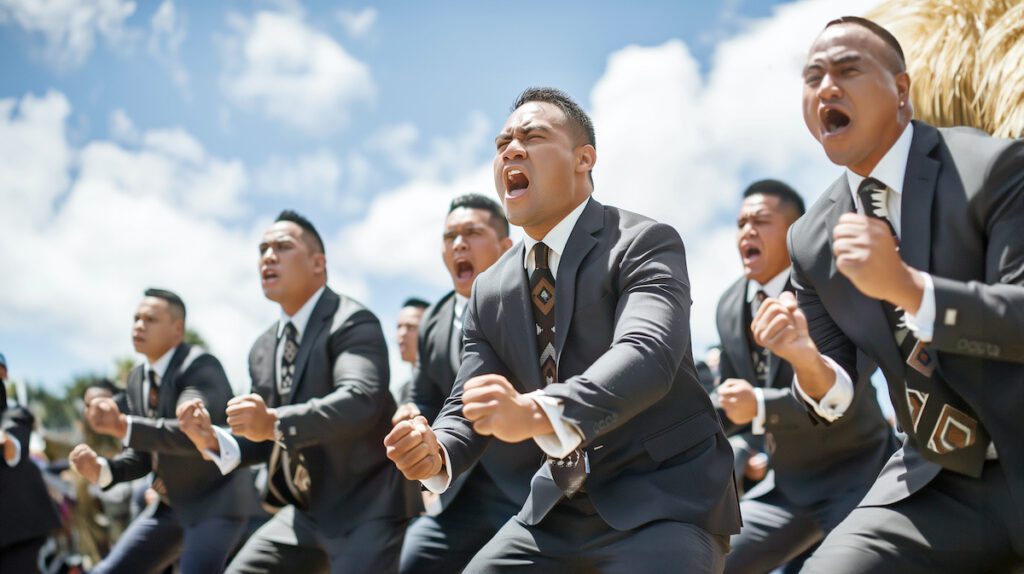
Rituals also help to strengthen team spirit and facilitate cooperation. Sport is full of such rituals: the playing of national or club anthems before football matches, the coach’s pep talk in the dressing room, or the players gathering in a circle before the kick-off. The New Zealand national rugby team’s performances are particularly memorable. Before every game, the most victorious sports team in history performs the Haka, a Maori war dance, to get themselves and the fans in the right mood.
In companies, the approach to increasing motivation is certainly not quite as martial, but here too, rituals should be established to weld a team together. This could be anything from the team members taking turns to bring refreshments to a regular team meeting, to going for a walk together after lunch or using code words in communication. After a while, celebrating together can also become a ritual.
Rules: Ritualization of important workflows
Certain processes can also be ritualized. The aim here is to increase efficiency as well as team spirit. This includes, for example, “lessons learnt” rounds in which mistakes are discussed. In any case, the error culture is a field in which clear rules should apply that can also be ritualized. Feedback should be honest and criticism should be openly accepted. Mistakes must be openly admitted and must not be condemned by either the team leaders or colleagues. This requires open communication and communication skills such as active listening. The goal should always be to work together to find ways to avoid repeating mistakes.
T.E.A.M: Together Everyone Achieves More
Last but not least, the question arises: How do you start building team spirit? If you establish the five steps mentioned above (sense of belonging, collective heroes, common goals, common opponents and shared rituals), then you are already on the right track.
Winning in sports is the equivalent of economic success in the business world. Team spirit emphasizes what we have in common, which is also the approach I take in my keynote speech “The Stadium Principle: Winning Together”. How do you experience team spirit in your company? Feel free to post a comment. If you need more information on the topics of team spirit and team building or are looking for a keynote speaker on the topic, please send me an e-mail.






 Contact


